
At Cranbourne Primary School we provide a comprehensive curriculum based on the Victorian Curriculum 2.0, which is the current curriculum for Victorian schools. It incorporates the Australian Curriculum and reflects Victorian standards and priorities. The Victorian Curriculum Learning Areas Include:
- English
- Mathematics
- Science
- Health and Physical Education
- The Humanities
- The Arts
- Technologies
- Languages (Auslan)
There are four capabilities within the curriculum. The skills and knowledge defined in the capabilities will be developed, practised, deployed and demonstrated by students in and through their learning across the curriculum. These are:
- Critical and Creative Thinking
- Ethical
- Intercultural
- Personal and Social
There are also three cross-curriculum priorities which are embedded in the curriculum areas that provide students with knowledge and skills to engage with and better understand their world:
- Aboriginal and Torres Strait Islander histories and cultures
- Asia and Australia’s engagement with Asia
- Sustainability
Each week, students participate in lessons for English, Mathematics, specialist classes, Read to Learn, and Library sessions.
Each term, students are engaged in a Read to Learn, which highlights one of the Humanities areas of the curriculum (such as History, Geography, Civics and Citizenship, or Economics and Business) or a Science.
Learning spaces also incorporate ‘Circle Time’, ‘Respectful Relationships’, and ‘Zones of Regulation’ into their routines. These programs support the emotional wellbeing of students, helping them to regulate their responses to situations, and to effectively and respectfully interact with others.
Our Specialist program is as follows:
|
Grade level |
Semester One |
Semester Two |
|
Foundation |
Health & Physical Education, PMP, The Arts, Technology, Cultural Studies
|
Health & Physical Education, PMP, The Arts, Technology, Cultural Studies
|
|
Junior (Grades 1 & 2) |
Health & Physical Education, PMP (grade 1 only), The Arts, Technology, Cultural Studies
|
Health & Physical Education, PMP (grade 1 only), The Arts, Technology, Cultural Studies
|
|
|
|
|
|
Middle (Grades 3 & 4) |
Health & Physical Education, The Arts, Technology, Auslan (LOTE)
|
Health & Physical Education, The Arts, Technology, Auslan (LOTE)
|
|
Senior (Grades 5 & 6) |
Health & Physical Education, SEPEP, The Arts, Technology, Auslan (LOTE) |
Health & Physical Education, SEPEP, The Arts, Technology, Auslan (LOTE) |
(SEPEP - Sports Education in Physical Education Program / The Arts - Music and/or Visual Arts)
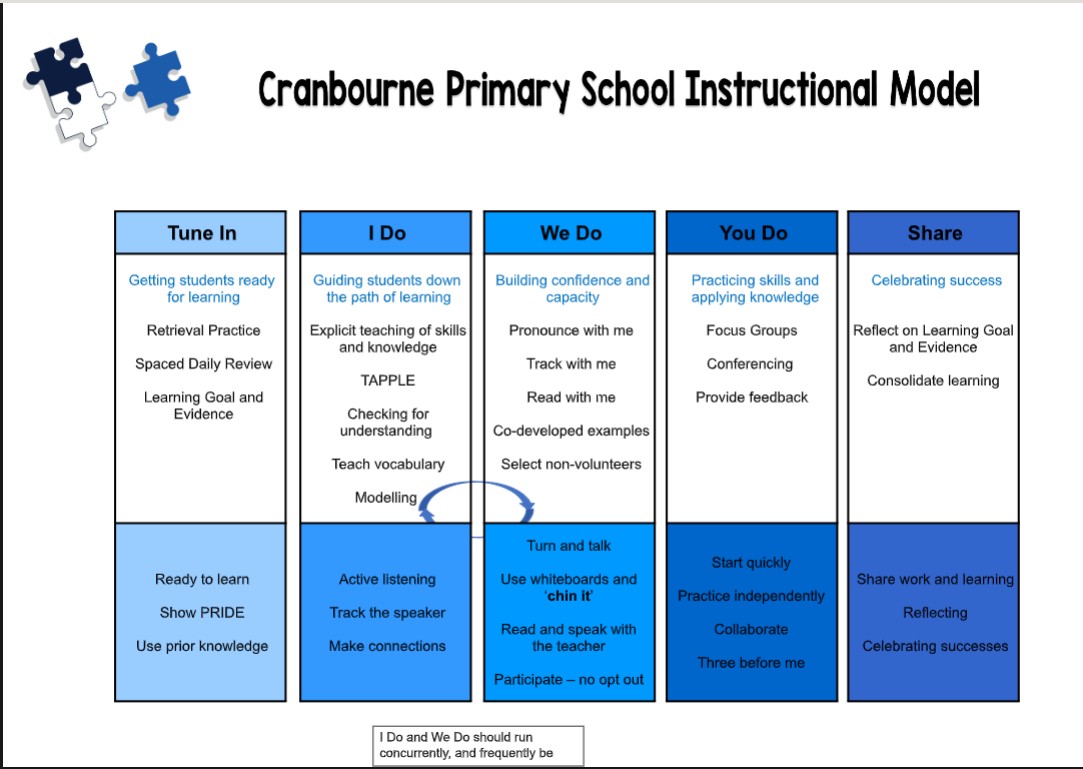
We teach using a gradual release of responsibility model that is underpinned by Explicit Direct Instruction and aligned to the Victorian Teaching and Learning Model.
Homework
Homework benefits students by complementing classroom learning, fostering good study habits and providing an opportunity for students to be responsible for their own learning. Students may be able to recall information immediately after they’ve learnt it, but without regular review, the ability to recall will fade. The biggest drop in retention happens soon after new learning. The more times we’re reminded about and practise using what we’ve learnt, the longer the interval until we need to be reminded about it again. Homework provides the opportunity to review and practice pre-learnt concepts and skills.
All students at Cranbourne Primary School are expected to read at home at least 5 nights per week. In Foundation to Grade 2, students will read their levelled reader, in order to support their reading fluency and comprehension. It is highly recommended that these students read with a capable reader who is able to correct and reinforce their practice. Students in Foundation to Grade 4 will have a reading log that must be filled in after each night of reading. Students in grades 3-6 may have a levelled reader, alternatively, these students will have a novel of choice that should be read at least 5 nights per week.
All other homework is recommended, but not required, this means that students who do not complete additional homework tasks (apart from reading) will not face punitive consequences.
Reporting Student Progress to parents
Student progress is also communicated through semester reports, with ongoing communication maintained through Student Support Group (SSG) meetings, one-on-one meetings, and growth meetings for students identified as at risk.
At the beginning of Term 1, a Community Night is held providing families with the opportunity to meet teachers and gain an overview of the learning programs for the year.
A formal interview, held mid-year following the distribution of semester reports, offers more detailed information about each child’s progress and development.
Parents wishing to discuss their child’s progress at other times are welcome to make an appointment with the classroom teacher.